
Customer consent under Vietnam's data protection law
Vietnam's data protection law applies to small shops: how to take consent for sign-up forms, Zalo OA, cameras and customer spreadsheets, and what is exempt.

Your shop keeps an Excel file of customer names, a Zalo OA page, a camera above the door and a stack of paper sign-up slips. All four are collecting other people's personal data.
From 01/01/2026 that has its own law: the Personal Data Protection Law No. 91/2025/QH15, which applies to household businesses as well as companies.
Why this is no longer the legal department's job
Three years ago this was a decree. Now it is a law, with clauses for each way data gets collected: paper slips, chat messages, cameras, customer files.
Data collection does not happen in a meeting room. It happens at the counter: a staff member hands over a form, whoever runs the fanpage answers a message, the camera records 24 hours a day.
And bad consent cannot be fixed afterwards: the data is already collected. You can delete it, but you cannot make that collection lawful.
Which law applies
The Personal Data Protection Law No. 91/2025/QH15 was passed on 26/06/2025 and took effect on 01/01/2026. It is Vietnam's first stand-alone law on personal data.
Before it, Decree 13/2023/ND-CP (issued 17/04/2023, effective 01/07/2023) governed the field. It has been replaced.
Decree 356/2025/ND-CP (issued 31/12/2025, effective 01/01/2026) is the current guidance: 5 chapters, 42 articles and an annex of 10 records and forms.
Be careful with older articles: many still cite Decree 13/2023/ND-CP, and some cite a document numbered 53/2022/QH15 even though that number is not a law on personal data.
What valid consent looks like
Article 9 sets the bar: consent is only valid when it is voluntary and when the customer clearly knows the type of data and the purpose, who controls the data, and their own rights and obligations.
Clause 3 of Article 9 adds form: consent must be clear, specific, and capable of being printed or copied, including in electronic or verifiable form.
Clause 4 adds four rules: consent per purpose; no bundling with a different purpose as a condition; consent lasts until the customer changes it; silence is not consent.
Clause 1 of Article 11 requires consent before collection. Article 10 lets the customer withdraw it, in writing including electronic form.
Four places in your shop are collecting data and nobody noticed
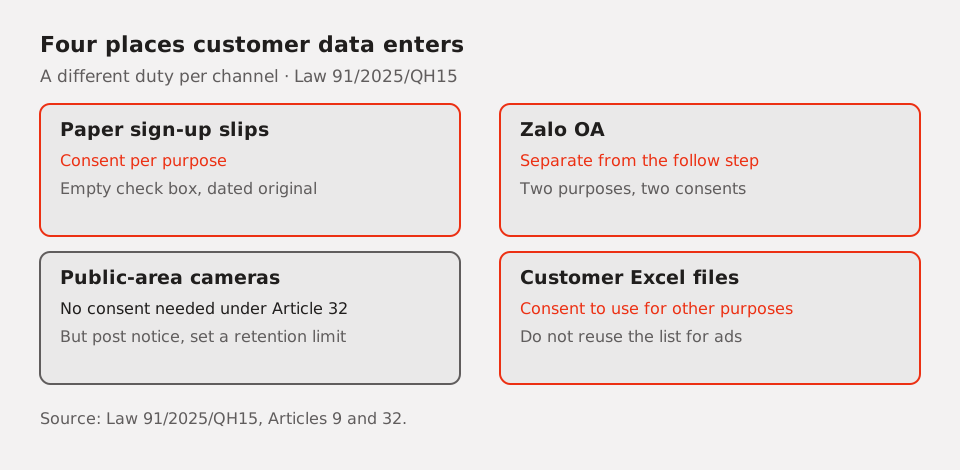
Paper sign-up slips. The customer writes a name and phone number to get promotions, but the only sentence on the form is usually for contact: no stated purpose, no way to decline.
Zalo OA. Following the OA is consent to receive messages from the platform, not consent for your shop to keep a customer record and reuse it for advertising. Two purposes, two consents; a Zalo OA chatbot for small business reading that conversation needs its own consent.
Cameras. Article 32 permits audio and video recording in public places and at public activities without consent in some cases, but clause 2 requires notice, clause 3 limits the purpose, and clause 4 requires storage only as long as necessary.
Invoices and the customer spreadsheet. An e-invoice is structured data, and it usually gets reused beyond the sale. Once you move to e-invoices generated from a cash register, you are holding a stream of customer data, enough for an AI chatbot that answers from your documents to answer from stored records.
| Channel | Data collected | Consent needed? | What to do |
|---|---|---|---|
| Paper slips | Name, phone number | Yes, per purpose | Print the purpose and a blank check box; keep the dated original |
| Zalo OA | Display name, phone number | Yes, separate from following the OA | Show a consent screen before the first message |
| Cameras | Images of passers-by | No, when recording a public place under Article 32 | Post a notice sign; set a retention limit |
| Invoices, Excel files | Name, phone number, purchase history | Yes, if used beyond the sale | Restrict folder access; do not reuse the list for ads |
Customers who consented under Decree 13/2023/ND-CP before 01/01/2026 do not have to be asked again; only the record has to meet the new standard (Article 39 clause 1, Law 91/2025/QH15).
Three consent wordings you can use today
These three follow clause 2 of Article 9. Copy them and replace the brackets.
Web form: I agree that [shop name] may store my name and phone number to send promotions by Zalo and email. I can withdraw at any time by messaging the OA. The check box starts empty.
Zalo OA: To receive promotions from [shop name], tap Agree. We store your display name and phone number for this purpose. Tap Decline or reply STOP to withdraw.
Loyalty card: I agree that [shop name] may use my name, phone number and purchase history to calculate points and send offers. Do not make marketing consent a condition of buying.
Where to keep consent evidence
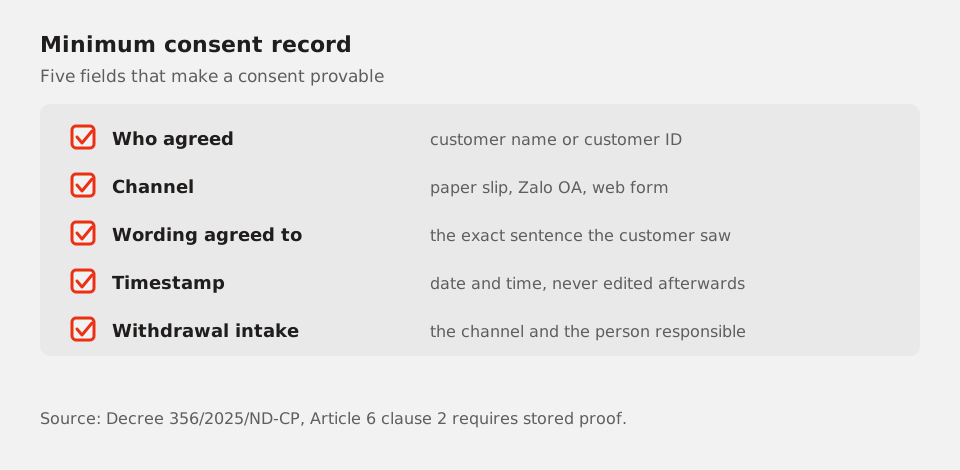
Clause 2 of Article 6 of Decree 356/2025/ND-CP requires you to store the consent, and when a dispute arises the data controller must prove it. Clause 1 lists five verifiable methods, each showing who, when and what: written text; recorded calls; a syntax sent by phone message; email, websites or apps with a technical consent setting; and other printable or copyable methods.
Clause 3 bans default consent and misleading prompts. Clause 4 requires telling the customer explicitly when the data is sensitive.
How long to keep it? Long enough to prove consent when asked; there is no single number. For cameras, clause 4 of Article 32 requires storing only as long as necessary.
A minimum record holds: customer name, channel, the wording they agreed to, the timestamp, and the original if there is one.
The impact assessment file
Clause 1 of Article 21 requires a written personal data processing impact assessment, kept on file and submitted to the specialised agency within 60 days of the first processing. Article 22 requires updates every 6 months when processing changes.
Most small shops do not have to do this. Clause 2 of Article 41 of Decree 356/2025/ND-CP exempts household businesses and micro-enterprises from Articles 21 and 22 and from clause 2 of Article 33.
There are three exceptions: providing data processing services; processing sensitive personal data directly; or processing data of 100,000 data subjects or more. Small and start-up enterprises may choose to comply or not for 5 years, under the same three exceptions.
A 20 to 50 person company should not assume it is a micro-enterprise. And being exempt from the file does not exempt you from consent: Articles 9, 10 and 11 still apply.
Sending data abroad
Point c of clause 1 of Article 20 treats using a platform outside Vietnam to process data collected in Vietnam as a cross-border transfer. The question is not whether you meant to transfer, but where the data sits.
Clause 2 requires a transfer impact assessment, submitted within 60 days of the first transfer. Point b of clause 6 exempts employee data held on a cloud computing service: staff data, not customer data.
What to do: ask your provider where the data is stored and whether it leaves the country. The answer is in the contract or the policy page. Size does not matter here: Google Sheets, Zalo, Mailchimp and OpenAI all fall in the same bucket, including free AI tools for small business.
What to do in 30 days
You do not have to finish in a week. Work in this order.
- List the four places that hold customer data: paper slips, Zalo OA, cameras, Excel files.
- For each, write down the real purpose. A purpose that is not in the sentence the customer agreed to is a place to fix.
- Fix the wording first, the software second.
- Open one place to receive withdrawal requests and log the date.
- Ask your provider where the data is stored; if it is abroad, flag it.
Automate after that: what an AI agent is covers the layer that touches customer data directly.
Conclusion
Asking for consent is not paperwork to get around. It is the one point in the chain where the customer says what you may do with their data.
Three things matter most: ask before collecting, keep proof, let the customer withdraw. The rest of the law has exemptions for household businesses and micro-enterprises; these three do not.
Question: A customer already follows our Zalo OA. Do we need separate consent?
You do not need to ask again for following, but you do need separate consent if you use that list for something else: keeping a customer record, sending advertising. Agreeing to platform messages is not the same as that second consent.
Question: If we are exempt from the impact assessment file, do we still need consent?
Yes. Clause 2 of Article 41 of Decree 356/2025/ND-CP exempts household businesses and micro-enterprises from the impact assessment file, not from Articles 9, 10 and 11.
Question: Does a shop camera need every customer's permission?
No consent is needed for recording a public place or public activity in the cases Article 32 allows, but you must give notice, use the footage only for that purpose, and keep it only as long as necessary.
This article summarises the rules so you know what to ask; it is not a substitute for legal advice.
Sources: Personal Data Protection Law No. 91/2025/QH15, Decree 356/2025/ND-CP, Decree 13/2023/ND-CP (superseded on 01/01/2026).