
Vietnam e-invoice rules for small shops: thresholds
Decree 254/2026/ND-CP governs e-invoices from 1 July 2026: shops over 1,000,000,000 VND must use cash-register e-invoices, with fines of 1–80 million VND.

E-invoices stopped being an accounting problem
For years an e-invoice in Vietnam was an accounting chore: the accountant generated a file, sent it to the tax office, and nobody else looked at it. Decree 254/2026/ND-CP, issued on 30 June 2026 and effective from 1 July 2026, replaced Decree 123/2020/ND-CP and Decree 70/2025/ND-CP, and it moves the point of issue from the back office to the cash register. Most guides, vendors and accountants still describe the previous regime. Check the instrument before you buy anything.
That shift matters more than the paperwork it replaces. When a shop issues an e-invoice from a cash register connected to the tax authority, the sale becomes a structured record at the moment it happens. The tax authority receives it, and so does the shop's own software. For the first time, a small Vietnamese shop's sales data is machine-readable by default, not reconstructed at month end from a notebook.
This article is for an owner, country manager or investor looking at a Vietnamese SME: who is caught, the three e-invoice types, how penalties scale, what compliance costs, and the data asset underneath.
Who is actually mandated from 1 July 2026
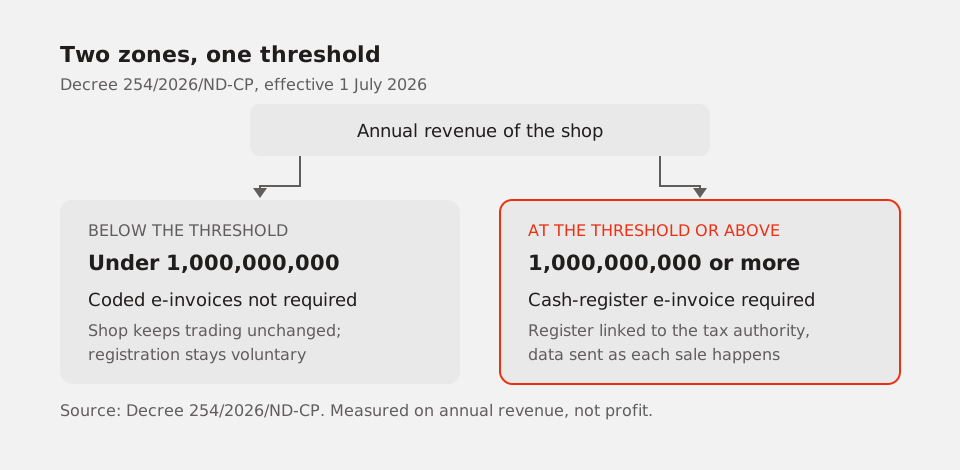
The governing text is Decree 254/2026/ND-CP, which details the Law on Tax Administration 108/2025/QH15. The threshold is one number, not a band with a middle. Household businesses with annual revenue from 1,000,000,000 VND upward, in sectors selling directly to consumers, must use cash-register e-invoices. The official line is blunt: below 1 billion VND, coded e-invoices are not mandatory.
That gives two zones, not three. Above the line, the obligation is to issue e-invoices from a cash register connected to the tax authority, with data transmitted as the sale happens. Below the line, coded e-invoices are not mandatory and a household business can keep trading without them.
Scope is defined by what the business does, not only by size. The rule covers businesses selling goods or services directly to consumers in shopping centres, supermarkets, retail, food service, restaurants, hotels and passenger transport. A wholesaler selling to other businesses is a different case; a restaurant taking money at the counter is not.
Three kinds of e-invoice, and where they differ
The Law on Tax Administration 108/2025/QH15 recognises three e-invoice types, and Decree 254/2026/ND-CP details how each is used. Confusing them is the most common source of bad advice.
The first is the coded e-invoice, which carries a code issued by the tax authority. It is the default for businesses that invoice after the fact: a workshop, a consultant, a small distributor.
The second is the uncoded e-invoice, created by the seller's own system and transmitted without a tax-authority code. It suits businesses with the systems to generate, sign and store their own documents.
The third is the cash-register e-invoice, generated at the point of sale by a register connected to the tax authority, with data sent as the sale happens. This is the type the 1,000,000,000 VND threshold points at.
Where they differ is the data trail. A coded invoice tells the tax authority that a sale was reported; a cash-register invoice also tells it what was sold, when and for how much. Only the third type produces usable sales data item by item.
Penalties scale with the number of invoices
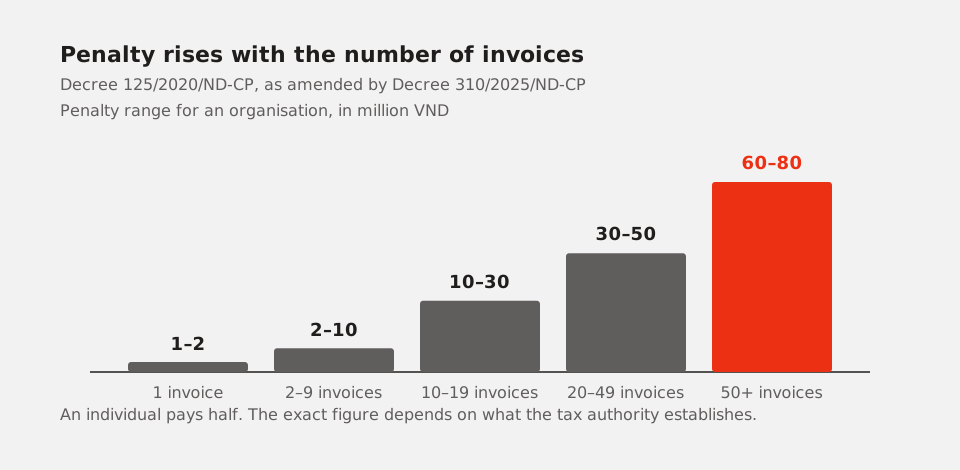
The penalty rules do not come from Decree 254/2026/ND-CP. They come from Article 24 of Decree 125/2020/ND-CP, as amended by Decree 310/2025/ND-CP, effective from 16 January 2026. That separation matters: one instrument tells you what to issue, another sets the fines when you do not.
The brackets are built around the count of invoices not issued, not the value of the sales behind them. That is deliberate. Counting is cheap to prove.
| Invoices not issued | Penalty for an organisation (VND) |
|---|---|
| 1 invoice | 1,000,000 – 2,000,000 |
| 2 to under 10 invoices | 2,000,000 – 10,000,000 |
| 10 to under 20 invoices | 10,000,000 – 30,000,000 |
| 20 to under 50 invoices | 30,000,000 – 50,000,000 |
| 50 or more invoices | 60,000,000 – 80,000,000 |
Those are organisation amounts; an individual pays half. The exact figure depends on what the tax authority establishes: the number of invoices, the period, cooperation, prior violations. Any article that promises a precise number is guessing.
The ceiling is where most summaries go wrong. Under Article 24 of the Law on Handling Administrative Violations the cap is 50,000,000 VND for an individual and 100,000,000 VND for an organisation per act, so the most actually imposable is 80,000,000 for an organisation and 40,000,000 for an individual. The 2 billion VND figure circulating online is the general Article 23 cap and does not apply to invoices.
What a year of compliance really costs
The software is the cheap part. A cash-register e-invoice service is priced per invoice or as a monthly subscription, manageable for a small shop. The expensive parts are the ones nobody quotes.
The first is the register itself. A shop with a modern POS and a tax-authority connection may need only a configuration change and a service contract. A shop running a ten-year-old till with no connectivity is buying hardware.
The second is the integration between the till, the invoice service and the accounting software. Quotes drift here, because the integration is bespoke work billed by the hour.
The third is staff time. Every sale now produces a document that has to reach the buyer. In a shop with a queue, that is a process change, and process changes need training.
The unadvertised prize: sales data that machines can read
Every rule above is a cost. The rule also produces an asset most shops have never had: a clean, item-level, timestamped record of what was sold, to whom and when.
Once a year of cash-register invoices exists, a shop can forecast next week's stock from its own history instead of the owner's memory. That is the boring, reliable version of automation, and it pays for the compliance work.
The same data makes an AI system useful rather than decorative. An AI chatbot that answers from real order and return records is a different product from one that answers from general knowledge; the difference is retrieval over your own data, the pipeline in the machine learning to RAG stack guide.
For a bank, the same record is a loan file. Lenders price risk on evidence. A shop that can show a year of machine-readable sales has evidence; a shop that shows a notebook does not.
Five things to do in two weeks
A two-week plan, in order, for an owner who has just realised the threshold applies.
- Confirm your revenue against the 1,000,000,000 VND line with your accountant, in writing. Use the declared annual figure, not a guess from the bank statement.
- Ask your POS vendor whether the register can issue cash-register e-invoices connected to the tax authority, and what the connection costs per month. Get it in writing.
- Separate the invoice cost from the integration cost in any quote.
- Train one person per shift, not one person per shop. The mandate is about every sale, and one trained cashier covers one shift.
- Export a month of invoices and look at the data before automating anything. The free AI tools for small business guide is a reasonable shortlist, and if the data is clean, an AI agent becomes a realistic next step.
Two weeks will not finish the project, but it will tell you whether your vendor and accountant are ready.
Five mistakes shops make
The first is assuming the threshold is a cliff you can stand behind. Revenue is measured over a year, and a shop that grows through 1,000,000,000 VND mid-year does not get a fresh start.
The second is buying a register that produces a receipt but not a tax-authority e-invoice. A receipt is not an invoice, and the penalty counts invoices.
The third is treating the invoice as a document rather than a data stream. Shops that print a copy and file it do the paperwork and miss the asset.
The fourth is wiring a chatbot to sales data without checking the answers. This is the failure mode in why AI chatbots fail: the model sounds certain, the numbers are wrong, and the owner finds out from a customer.
The fifth is following a guide written for the previous decree. Three-band thresholds and obsolete fine bands still circulate, and they cost money.
Frequently asked questions
Do I need a cash-register e-invoice if my revenue is under 1,000,000,000 VND a year? No. Decree 254/2026/ND-CP makes cash-register e-invoices mandatory at 1,000,000,000 VND and above in consumer-facing sectors; below that line coded e-invoices are not mandatory, though voluntary registration is allowed.
What is the fine if I miss a few invoices? For an organisation: 1–2 million VND for one invoice, 2–10 million for two to under ten, 10–30 million for ten to under twenty, 30–50 million for twenty to under fifty, and 60–80 million for fifty or more, under Decree 125/2020/ND-CP as amended by Decree 310/2025/ND-CP. An individual pays half.
Can a customer demand an e-invoice? Yes. Issuing an invoice on sale is mandatory under the Law on Tax Administration 108/2025/QH15, and the buyer has a statutory right to demand the e-invoice. Any document can be checked at the tax authority's public lookup, tracuuhoadon.gdt.gov.vn.
The short version
If annual revenue is 1,000,000,000 VND or more and you sell directly to consumers, Decree 254/2026/ND-CP requires e-invoices from a cash register connected to the tax authority, from 1 July 2026. Below that line, coded e-invoices are not mandatory. Penalties come from a different instrument and scale with the count of invoices not issued, from 1–2 million VND for one to 60–80 million for fifty or more, with individuals paying half and a hard ceiling of 80 million for an organisation. The compliance cost is real but bounded; the machine-readable sales data it creates is not.
This summarises what to ask about; it is not tax advice.
Sources: Decree 254/2026/ND-CP, Decree 125/2020/ND-CP as amended by Decree 310/2025/ND-CP, and the Law on Tax Administration 108/2025/QH15.