
AI chatbots for small business: answers from your documents
How small businesses build an AI chatbot that answers from their own documents, when to build one, what it costs, pilot in two weeks and how to keep data safe.

The first question when you build a chatbot is not which model to pick. It is which model knows your own documents. Every day, sales staff, support agents and internal teams repeat the same questions: "How long does a return take?", "How many products are covered by warranty?". The answers live in contracts, FAQs, internal procedures and handbooks. An AI chatbot that answers from documents is one that reads those sources, answers from internal data, and cites the source. It is not the usual chatbot, which answers from a large model's memory. This is the retrieval, generation and citation side that the RAG guide already covers step by step.
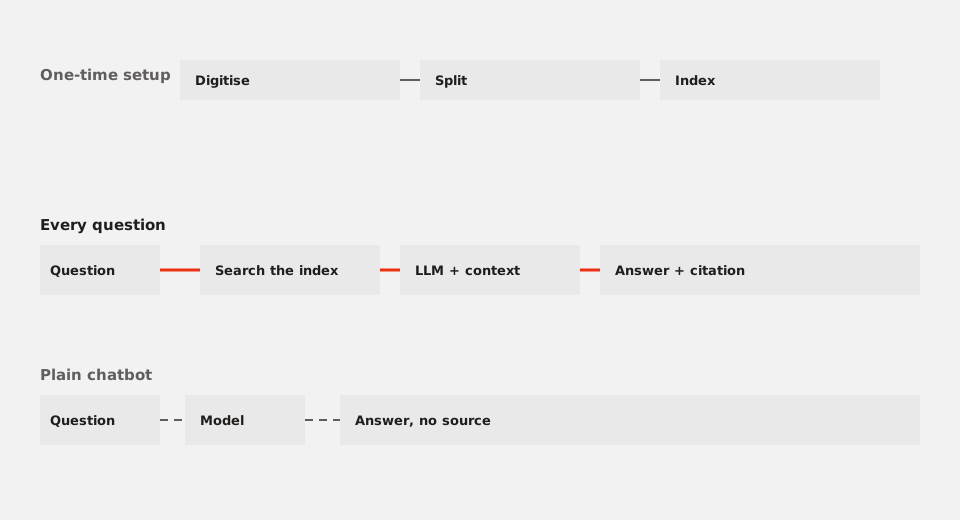
*Figure 1. Question enters, chatbot retrieves relevant documents, generates answer and cites source.
What is an AI chatbot that answers from documents?
A chatbot that answers from documents has three parts: retrieval, generation and citation. When a question comes in, the system finds the most relevant document chunks, puts them into the model's context, then generates an answer. Finally, the answer is attached to the source documents it rests on.
This is different from a regular chatbot. A regular chatbot sends the question straight to the language model and relies on its training memory, so the answer may be fluent but cannot be checked against any document of your company. The document-grounded chatbot still calls the model, but before every generation it needs document chunks. That is the difference that lets it verify answers when documents change.
In the chunking guide, the way chunk boundaries affect retrieval quality is explained. A document-grounded chatbot cannot skip that step, because it still has to choose which chunk goes into the model.
The reason this matters in practice is simple. Two companies can ask the same question and get different answers, not because the models differ, but because their documents differ. The chatbot is only as good as the sources it is allowed to use.
The practical consequence is that a small business rarely has clean handbooks from day one. Documents arrive as email threads, scanned PDFs, spreadsheets and chat logs. The chatbot works, but the quality ceiling is the quality of the sources it may read.
The citation is not decoration. It is what turns a chat answer into something a human can check. Without a source, the answer is a confident guess. With a source, the reader can open the document and verify. This is the habit that separates a useful chatbot from a demo.
The split between retrieval and generation matters for cost and for trust. Retrieval decides which document enters the context, generation decides how to phrase the answer. A small business does not need a fancy model; it needs a good context and a good source.
Four things it does well
A chatbot that answers from documents does not need to do all four things at once, but when it does, the value is clear.
- Policy and FAQ lookup. Imagine a bakery. A customer asks about return policy and warranty length. The chatbot answers from the stored document, and staff stop repeating themselves. With an agency, the same role needs briefs, scopes and contract terms, and the chatbot helps the team look up answers quickly.
- Technical and specification lookup. A distributor asks about inbound procedures and post-receipt checks. The chatbot answers from the documented process and reduces load on specialist staff.
- Internal onboarding. A clinic answers internal users about intake procedures. The chatbot reads internal documents and keeps answers consistent between staff.
- After-sales support. A customer asks about warranty. The chatbot answers from the documented warranty policy, instead of relying on a few staff members' memory.
Each use case shares the same shape: question in, retrieval finds source, generation produces answer, citation records source.
When is a document-grounded chatbot not enough?
Do not build one yet when all of these are true.
The first is low repeat volume. If staff answer only a few questions a week, a chatbot tool may not be worth building.
The second is unclean documents. The chatbot does not fix documents; it answers what is there. Dirty sources produce weak answers, just like bad chunks do in RAG.
The third is judgment. Policies can be answered by machines; contracts and specific situations need people.
The fourth is ownership. Someone must keep sources updated, otherwise the bot answers from stale documents and the team stops trusting it.
The related signal is not only how often questions repeat. It is who answers them. If one person answers the same question every week, the problem is process discipline, and a chatbot will not fix it. If many people answer it inconsistently, that is exactly the case a chatbot addresses.
This is not a reason to avoid chatbots; it is a reason to build at the right time.
Three options, choose by question type
| Option | Does | Does not | Best when | Initial cost |
|---|---|---|---|---|
| Ready-made tool | Summarises and looks up from files you upload | Keeps no internal policy and cites nothing | Trying the idea on a few documents | Low |
| Scripted bot | Fixed flows, menus, common questions | Cannot answer outside the script | A short list of repeated questions | Medium |
| Custom RAG | Retrieves from your documents, answers with citations, integrates with your channels | Needs source cleaning, evaluation and maintenance | Many repeated questions across many documents | High |
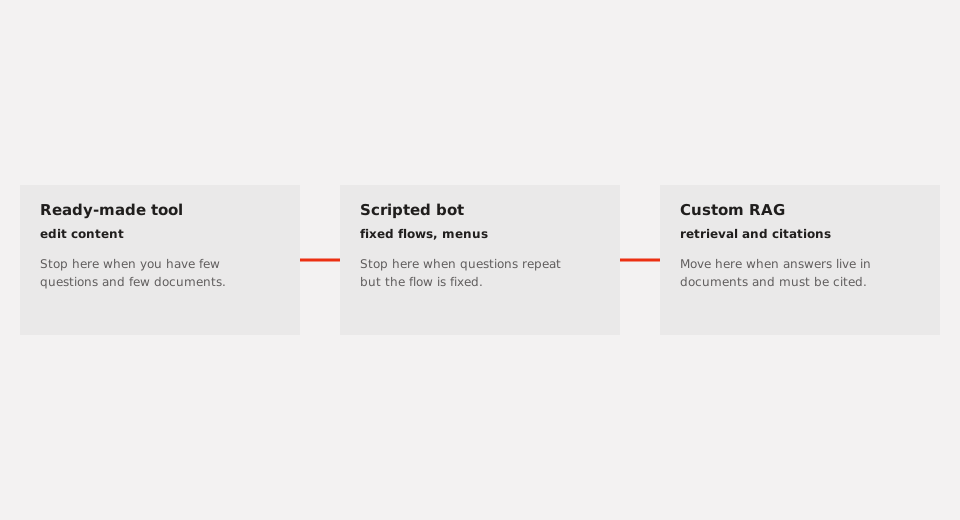
*Figure 2. Three options: ready-made tool, scripted bot and custom RAG.
If you want to try the idea first, free AI tools is the roundup to start from.
What the cost includes
Costs come from four drivers. Source cleaning is usually the biggest. Channel integration and access control come next. Evaluation follows. Maintenance closes the loop. Per-answer API and model cost is small at small-business volume; exact numbers should come from scoping, not from guesses here.
Evaluation is cheap at this scale and skipping it is not: without a golden set, teams tune prompts without measuring answers. Maintenance closes the loop — documents, questions and models all change, and a pilot without a maintenance owner becomes a demo.
Ship in two weeks: 5 steps
- Pick one workflow, for example return policy lookup.
- Collect 50 real questions and the sources behind them.
- Pilot on 20 to 50 documents with mandatory citations.
- Measure with real staff.
- Integrate one channel, website or internal chat.
Each step has an acceptance check. Step three must produce citations. Step four must produce a number of questions whose handling time dropped.
The two-week limit is a planning device, not a promise. The first week is sources, the second is the pilot. Cutting corners here shows up later as missing citations or drifting answers.
Measuring effectiveness
Use a golden set of 30 questions. Measure four metrics: answer accuracy, citation correctness, escalation rate, time saved per question. The number of messages is not a success metric.
Without a fixed set of questions, every answer is anecdotal. The golden set turns opinion into comparable numbers, and the four metrics turn numbers into a decision. The goal is not a perfect score. The goal is a defensible number that the team can act on.
Data security
Per-user access control, no customer PII into public tools, logs and retention, storage location. Caution is required; no legal guarantee is offered.
The checklist matters because small businesses often store documents that contain customer names, order history or internal notes. The chatbot should not widen that surface.
Conclusion
You now know enough to decide: a document-grounded chatbot fits when internal policy needs consistent answers. If your business is waiting for repeated questions to justify building, start with one real workflow. Cross Tech Edu's AI/Data team spends 30 minutes designing the pilot.
The recommendation is simple: pick one repeated question, keep the answer sourced, measure, then expand.
FAQ
Does it replace staff?
No. It supports lookup, it does not replace decisions.
How many documents to start?
From 20 to 50 documents for a pilot.
Can it run on Zalo or Facebook?
Yes via API, but approval and platform fees depend on the platform; confirm before promising.