
AI hallucination: how small businesses can reduce it
What AI hallucination is, why chatbots invent facts, and five practical ways small businesses can cut the risk before customers see a wrong answer online.

Imagine a small clothing shop. A customer messages: "Can I return something I bought on sale?" The owner asks an AI chatbot to draft a reply. It answers at once, in a confident tone: "Sale items can be returned within 7 days with a receipt." The shop has never had that rule. Send that answer as it stands and the owner has just created a policy that does not exist.
That has a name. AI hallucination is when an AI model gives information that sounds right but is wrong or made up, and states it with confidence. This article covers what it is, why it happens, where a small business gets hurt, and five practical ways to reduce it. Each part is explained with examples from an ordinary shop's day, not from a lab.
What is AI hallucination?
In short: the model does not check your own documents before it answers. It writes by picking the words most likely to come next, based on the very large amount of text it read during training. Most of the time that produces a correct answer. But where the answer needs a number, a name or a specific clause, it keeps writing — smoothly.
A simple picture: someone who read a book a few years ago and now retells it. They remember the gist, forget some details, and fill the gaps with details that sound right. The listener has no copy of the book, so the seams are hard to see. The model does not know it is inventing either, which is why the tone stays as confident as when it is correct.
Common shapes of it in a small shop:
- A price that is not on your price list.
- A return or warranty policy you never wrote.
- A legal clause that sounds right but does not exist.
- A phone number with a digit or two wrong.
- A product you have never sold, complete with specs.
Why does AI make things up?
Three reasons, no technical background needed.
It predicts the next words; it does not check facts. The job it was trained for is producing text that looks like real text. A fluent wrong answer is still a valid output, because nothing in that step opens a document and compares.
It does not know your private documents. Today's price list, the policy you edited last week, how you calculate delivery: none of that was in the training data. Unless you put it in front of the model, the model answers from general knowledge — or from a guess.
A vague question leaves gaps, and the model fills them. Ask "what is the return policy?" without saying which shop or which product, and something has to fill the space. What fills it is a plausible average, not your rule.
Why should small businesses care?
For a small business, the cost of a wrong answer is rarely technical. It lands on the customer relationship. A wrong price can lose a sale or force you to sell at a loss. An invented policy can start a refund argument you have no basis to refuse. A delivery promise the model made up becomes a promise you cannot keep.
Time matters too. A small team has few people, each doing several jobs. When messages pile up in the evening, re-reading every chatbot reply is the first thing to be skipped. The easier it is to send, the more likely it goes out unchecked.
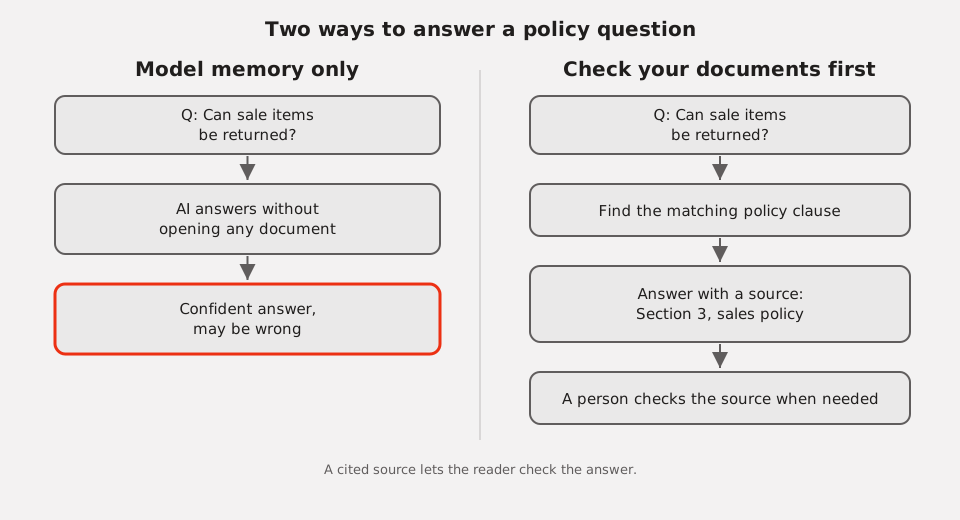
Figure 1. An answer from memory can be invented; an answer from your documents comes with a source to check.
Where AI makes things up most often
Not every answer carries the same risk. These types of information are where invented facts show up most, and also where a quick check is easiest.
| Type of information | Example | Quick check |
|---|---|---|
| Prices and promotions | "This shirt is 199,000 VND, 20% off until Sunday" | Open your own price list |
| Return and warranty rules | "Returns within 7 days, no receipt needed" | Re-read the policy page you published |
| Legal and tax rules | "A household business must file a new tax form this week" | Ask your accountant or check the tax authority's site |
| Contact details and hours | Phone number, address, lunch break | Open your contact page or Google profile |
| Product specs and stock | "Size M in stock, ships in 2 days" | Check real stock before promising |
A small habit helps: if an answer contains a number, a name or a date, treat that as the first place to check.
5 ways to reduce AI hallucination in a small business
None of these makes AI stop inventing things entirely. Together they remove most of the risk, and all of them work without writing code.
-
Give the AI your documents before it answers. Instead of letting the model reply from memory, hand it your price list, policies and product descriptions, and tell it to answer only from those. This is called RAG: the tool finds the relevant passage first, then the model writes the answer. If you are starting out, read the basic RAG guide first.
-
Require a source for prices, policies, numbers and names. No source means the answer does not go out as fact. "I don't have that information yet, let me check" is worth more than a wrong number. When an answer does cite a document, your staff only needs to open that one page.
-
Let the AI say "I don't know" and hand over to a person. A model tends to invent less when you allow it to say 'I don't know'. Write the handover sentence in advance and name the person who receives it, so hard questions land with a human instead of a guess. See how a Zalo OA chatbot hands off to people if your customers message you on Zalo.
-
Test with a set of real questions. Take 20–30 questions customers actually ask, run them through the chatbot, and mark each answer right or wrong. Re-run the set whenever a price or policy changes, because changed documents change the answers. This is the same check described in AI chatbots that answer from your documents before a bot goes live.
-
Put a person in front of high-risk replies. Prices, refunds, commitments, legal points: those four should wait for a human to press send. The rest — opening hours, how to order, general information — can go out automatically. For how an approval gate like that is built, see What is an AI agent?.
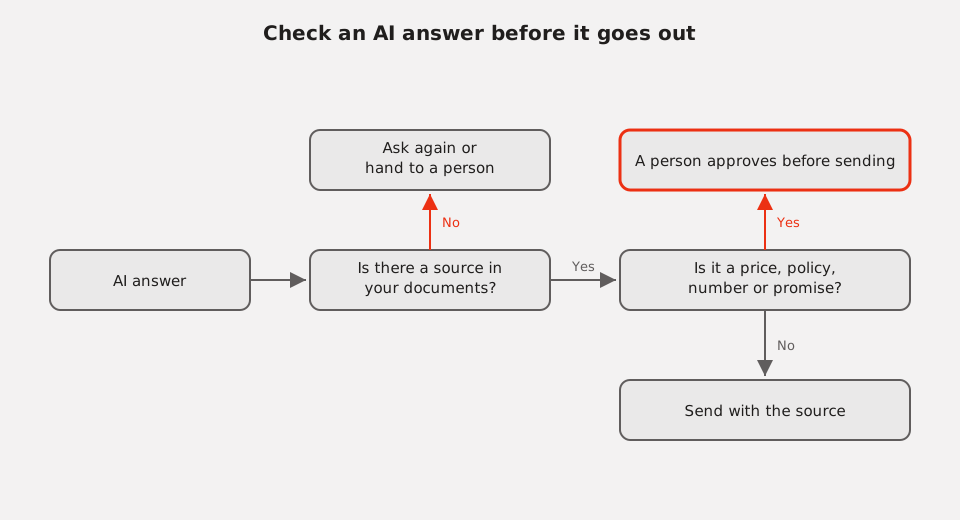
Figure 2. Before sending: no source means ask again or hand the question to a person.
Before you start
- Do not paste ID numbers, card numbers or sensitive customer data into public AI tools. Put in only what you would be comfortable with someone else reading.
- Start with one kind of question, for example prices and stock, rather than opening the bot to everything at once. Get one kind right, then widen.
- Write every wrong answer into a small log, with the question that produced it. Many errors trace back to a missing or outdated document, so fix the document, not only the reply.
Conclusion
No method makes AI never wrong. The realistic goal is fewer errors, and catching the rest before a customer sees them. Three habits carry most of the value: give the AI the right documents, require a source, and let a person approve the answers that matter.
If you want help designing the checks, the AI/Data team at Cross Tech Edu can help.
Frequently asked questions
Is there a way to make AI never invent anything?
No. Every method reduces risk rather than removing it. A practical approach combines three things: correct source documents, a citation requirement, and a person who approves the important replies.
Does RAG remove hallucination completely?
No. RAG reduces the risk when the document is right and the right passage is found. If the document is wrong, the answer is wrong too — it just comes with a source attached.
Can free ChatGPT or Gemini still make things up?
Yes. Free and paid versions can both invent details, especially when the question needs a specific number or rule. For prices, policies or legal points, check the official source before you use the answer.