
Vietnam AI Law 134/2025: Small Business Risk & Compliance
Vietnam's AI Law 134/2025 applies to small businesses: risk classification, notifying the Ministry of Science and Technology, labeling AI-generated content.

Your small shop already uses a chatbot for customer care, an AI tool that writes ads, or software that recommends products? Since 01/03/2026, all of that falls under Vietnam's AI Law No. 134/2025/QH15. This is a binding law, not a draft or a strategy. If you use at least one AI system in sales, this article is for you.
Vietnam's AI Law brings artificial intelligence into the country's binding legal framework for the first time. It does not only protect consumers; it gives small businesses clear duties: know the risk level of each AI system you use, notify the authorities when the law requires, and label content created by AI. This article sums up what you must do, in the language of a shop owner, not a lawyer.
Why Vietnam's AI Law 134/2025 matters for small shops
Law No. 134/2025/QH15 was passed by the National Assembly on 10/12/2025 and took effect on 01/03/2026. It has 8 chapters and 35 articles. It is a binding legal text that applies to every business using AI, including small shops and household businesses.
If your shop uses an AI chatbot for advice, an AI tool that writes ads automatically, or software that recommends products, you are using AI. The law requires you to classify each system by risk level before putting it into operation. It is not only big tech companies or large enterprises that must comply. Ignoring it can lead to fines, so shop owners should understand it early and act before an inspection. Even a single chatbot counts as a system under the law. Start with your customer-facing tools first.
Which law applies
The main law is Law No. 134/2025/QH15, effective from 01/03/2026. It sets the framework for prohibited, high-risk and low-risk AI, and the duties of AI users.
Decree No. 142/2026/NĐ-CP, issued on 30/04/2026 and effective from 01/05/2026, has 8 chapters and 46 articles. It is the implementing guidance for Law 134/2025/QH15, requiring small shops to classify their AI systems by risk level before use.
The two texts go together. The law sets the framework; the decree tells you exactly how. If you come across older guidance citing a different decree, check the effective date before relying on it.
Three risk levels of AI
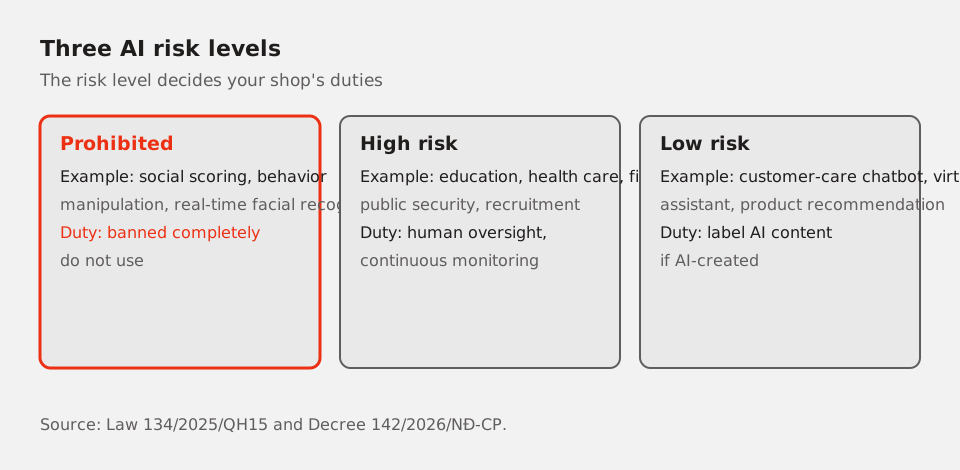
The law divides AI systems into three risk levels. The level decides your shop's duties.
Prohibited: social scoring, behavior manipulation, real-time public facial recognition (except as provided). These systems are completely banned and must not be used.
High risk: education, health care, finance, public security, labor recruitment. These systems need human oversight and continuous monitoring. A shop using a high-risk system must comply strictly.
Low risk: customer-care chatbots, virtual assistants, AI marketing content tools, product recommendations. Not mandatory to notify the authority, but if the system creates AI content, it must be labeled.
| AI system | Risk level | Main duty |
|---|---|---|
| Social scoring, real-time public facial recognition | Prohibited | Do not use |
| Education, health care, finance, public security, recruitment support | High risk | Human oversight, continuous monitoring |
| Customer-care chatbot, virtual assistant, ad writing, product recommendation | Low risk | No mandatory notification, label AI content |
Classify your business's AI systems
First, list every AI tool your shop uses: a Zalo OA chatbot, an AI ad-writing tool, product-recommendation software, a camera-based customer counting system.
Under Decree 142/2026/NĐ-CP, the provider or user must classify their AI system by risk level before putting it into operation. You do not wait for the authority to notify you; you assess and record it yourself.
Record what each system is used for, what data it collects, and which risk level it falls into. This record is your evidence if the authority inspects. Keep it simple: a spreadsheet with the system name, purpose, data collected and risk level is enough to start.
Learn how retrieval-augmented generation (RAG) works so you understand how shop data enters AI. A document-grounded AI chatbot is also an AI system whose risk level must be classified.
When to notify the Ministry of Science and Technology
One of the three core duties of the AI Law is to notify the Ministry of Science and Technology before using certain AI systems. Not every system must be notified.
Notification is mandatory for high-risk systems under the detailed rules of Decree 142/2026/NĐ-CP. Low-risk systems such as customer-care chatbots usually do not need notification.
But if a low-risk system creates AI content, you must label that content. This is a separate duty from notification. Know which bucket your system falls into before you act.
Labeling AI-generated content
The third core duty is to label AI-generated content. Customers have the right to know when they are interacting with content created by AI, not by a person.
The label must be clear and appear at the first interaction. It applies to automated messages, marketing emails, images and videos created by AI. You must not hide that the content was written by AI. A small line such as "This message was written by AI" at the start of the chat or email is a good start.
See free AI tools for small business to get started without spending much.
12–18 month transition for systems already running
If your shop has been operating an AI system before 01/03/2026, you have a transition period; you do not have to fix everything right away.
Most systems have a 12-month transition deadline. Systems in health care, education and finance have 18 months.
Household businesses and micro-enterprises have their own transition rules and do not have to comply immediately. But transition rules do not exempt you from all duties: risk classification and labeling AI content still apply. Treat the transition as breathing room, not a free pass.
Learn more about what an AI agent is to understand the next layer of automation after labeling.
What to do in 30 days
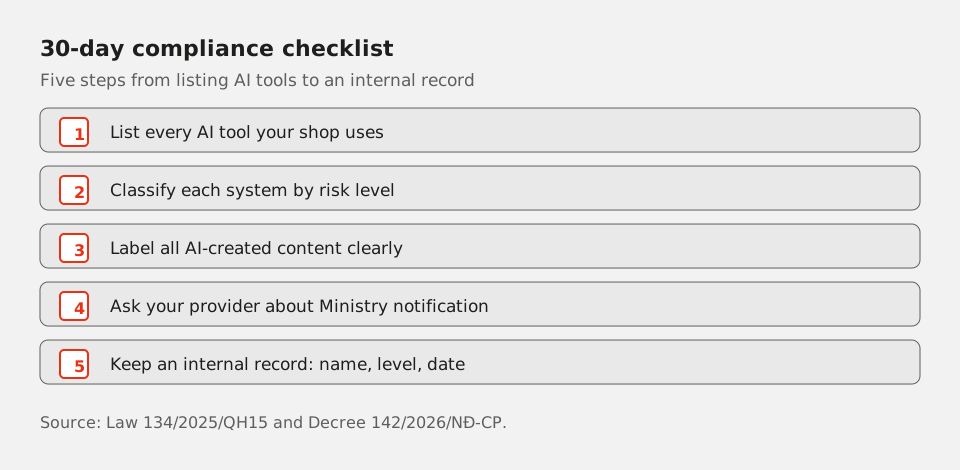
You do not have to do everything in one week. Do it in this order, one step at a time.
- List every AI tool your shop uses: chatbot, virtual assistant, AI ad writing, product recommendation.
- Classify each system as Prohibited, High risk or Low risk under Decree 142/2026/NĐ-CP.
- Label all AI-created content clearly, showing at the first interaction.
- Ask your AI software provider whether the system has been notified to the Ministry of Science and Technology.
- Keep an internal record: system name, risk level, classification date, who did it.
Learn more about machine learning basics to master the principles of running your shop's AI systems.
FAQ
Question: Does a small shop using a customer-care chatbot need to notify the Ministry of Science and Technology?
Answer: A customer-care chatbot is low risk and usually does not need notification. But if the chatbot creates AI content, you must label it.
Question: Are household businesses exempt from all AI Law duties?
Answer: No. Household businesses and micro-enterprises have transition rules, but core duties such as risk classification and labeling AI content still apply.
Question: Must the AI content label appear at the first interaction?
Answer: Yes. The label must be clear and appear at the first interaction between the customer and AI-created content.
Conclusion
Vietnam's AI Law 134/2025/QH15 is not only for tech companies. A small shop using chatbots, automated ad writing, or product recommendations must know its systems' risk level and label AI content.
The three most important duties: classify risk, notify when the law requires, label AI content. The rest of the law has transition rules for household businesses and micro-enterprises, but these three are not waived. Start with the five-step checklist in this article and review it every quarter. A short review now prevents a penalty later.
This article summarizes so you know what to ask; it is not a substitute for legal advice.
Sources: Law on Artificial Intelligence No. 134/2025/QH15, Decree No. 142/2026/NĐ-CP.