
Child abduction and organ trafficking: what parents must do
Child abduction and organ trafficking: what Vietnamese law says, warning signs, the first 60 minutes, and when to call 111 or 113 — a guide for parents.

Child abduction and rumours of organ trafficking are major worries for parents. The purpose of this article is to help parents stay calm and have specific steps to take when needed — no sensationalism, no alarmism, no premature conclusions. This article summarises Vietnamese law, warning signs, what to do in the first 60 minutes, and when to call 111 or 113.
Your child is late: what to do right now?
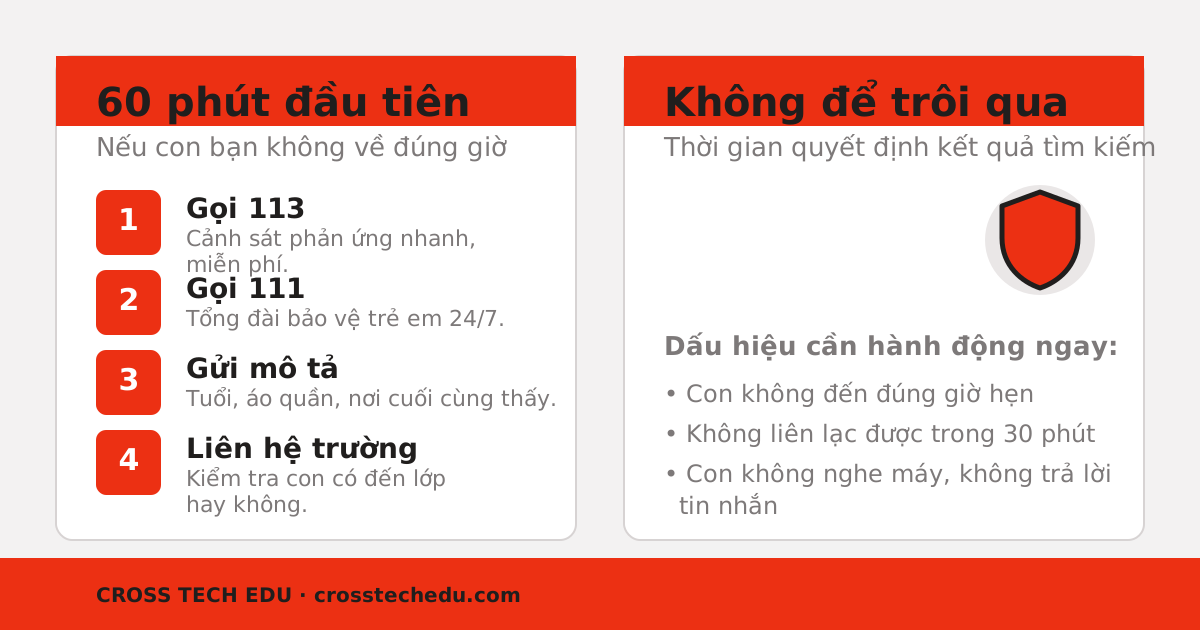
Do not wait until tomorrow. Call 113 (Police Rapid Response) and 111 (National Child Protection Hotline) right away, describing your child, the last time you saw them, and the last place you met. Both lines are free and operate 24/7.
What is child abduction under Vietnamese law?
Under the 2015 Penal Code (amended 2017), abducting or detaining a child under 16 by force, threat, or other means is the crime of taking custody of a person under 16, set out in Article 153. The penalty ranges are listed under "How does Vietnamese law handle abduction and human trafficking?" below.
Organ trafficking: what is confirmed and what is rumour?
No official source confirms cases of children abducted to harvest organs in Vietnam. Rumours spread on social media should be checked before sharing; parents should wait for official police statements.
Buying, selling, or taking custody of human organs or body parts is a separate offence under Article 154 (penalties listed below).
Warning signs that a child may be at risk of abduction
These warning signs help parents spot child abduction risk early and act quickly. A single sign does not necessarily mean a child is in danger, but several signs appearing together warrant closer attention and checking with the child or contacting authorities.
| Warning sign | What to do |
|---|---|
| Child does not return at the agreed time without notice | Call 113 and 111 immediately, give full details |
| Strangers frequently appearing near home or school | Note characteristics, driver, licence plate |
| Child walking alone in isolated areas | Remind the child to go in groups and not get into strangers’ vehicles |
| Child accepting gifts or invitations from strangers | Ask the child, encourage them to speak up |
| Child becomes fearful or secretive around one person | Talk with the child; seek psychological support if needed |
The table lists general warning signs and does not treat any specific person as a criminal without clear grounds.
The first 60 minutes: what to do if your child goes missing
If you suspect your child is missing, every minute counts. Act immediately: call 113 to report to Police Rapid Response, call 111 for the National Child Protection Hotline, give a full description, and contact the school, friends, and neighbours to check.
- Call 113 to report the case to the Police Rapid Response.
- Call 111 to be supported and counselled by the National Child Protection Hotline.
- Give a full description: age, clothing, identifying features, last place seen.
- Contact the school, friends, and neighbours to check whether the child has appeared.
- Stay calm so you can give clear information and help the authorities act quickly.
Acting fast in the first 60 minutes increases the chance of finding your child. Do not let panic delay your report.
How does Vietnamese law handle abduction and human trafficking?
Under the 2015 Penal Code (amended 2017), three offences apply, with penalties from 3 to 20 years, or life imprisonment in aggravated cases:
- Article 150 — Crime of trafficking in people: using force, threat, deception, or other means to transfer or receive a person in exchange for money, property, or benefits, or for sexual exploitation, forced labour, or taking the victim’s body parts. Punishable by 5 to 10 years in prison; if body parts have already been taken from the victim, the range rises to 12 to 20 years.
- Article 153 — Crime of taking custody of a person under 16: detaining or handing over a child under 16 to another person for detention by force, threat, or other means. Punishable by 3 to 7 years, higher if organised or if a position is abused.
- Article 154 — Crime of buying, selling, or taking custody of human organs or body parts: punishable by 3 to 7 years; serious cases (professional, causing death, six or more people) are punishable by 12 to 20 years or life imprisonment.
Recent high-profile cases: what is true?
Several rumours about child abduction and organ trafficking have spread widely on social media recently. Below is what the authorities have announced, and what remains a rumour.
1. Can Tho (23/09/2026): A rumour about child abduction in the Ninh Kieu district spread on social media. Ninh Kieu ward police (Can Tho) investigated and announced: the information is completely untrue; the story originated from a child’s imagination, and no incident occurred.
2. Thai Nguyen (25/06/2026): A post about a mother and child being abducted in Quyet Thang ward caused alarm on social media. Thai Nguyen provincial police said the information was unverified, and preliminary findings showed no signs of abduction.
3. Nghe An (16/04/2025): Two women posted unverified abduction information on social media. Nghe An police fined each woman 7.5 million VND for providing false information that caused public alarm.
4. Tra Vinh (03/11/2024): The investigating police of Chau Thanh district (Tra Vinh province) prosecuted the case and detained a woman for kidnapping a newborn at a hospital. This article does not name the accused.
How to check a rumour in 60 seconds
- Do not share immediately when you see a sensational post about child abduction.
- Look for information on the official website of the local police before believing it.
- Call 113 or 111 to confirm before acting.
- No official announcement? Treat as rumour; do not share.
How can parents prevent this in everyday life?
Prevention starts with regular conversation between parents and children, not only when something happens. Families should agree on times, places and who the child will meet, and teach basic safety rules for walking alone, accepting gifts, or getting into strangers' vehicles.
- Agree on the time and place your child will be, and ask them to tell you if plans change.
- Teach your child not to walk alone in isolated areas, not to accept gifts, and not to get into strangers’ vehicles.
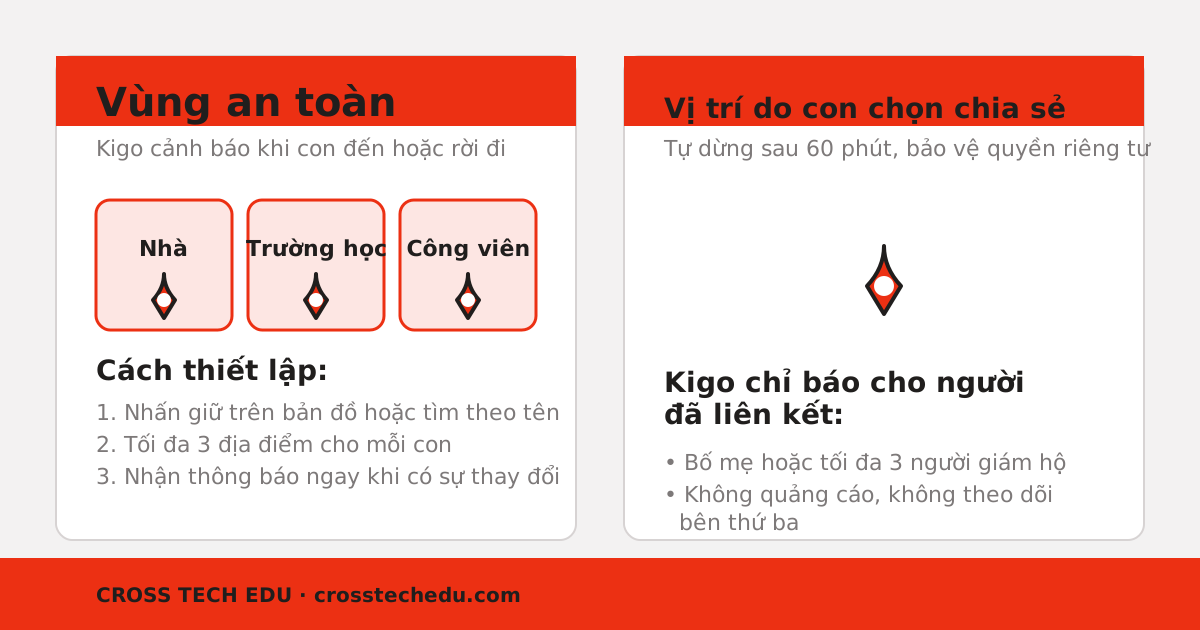
- Set up safe zones on the map and receive alerts when your child arrives at or leaves them.
- Encourage your child to share their location when needed, with a time limit (for example, stopping automatically after 60 minutes) to respect privacy.
- Make clear to your child who the trusted people are to call in an emergency.
- Avoid posting photos, names, schools, or detailed addresses of your child on public networks.
Things NOT to do if your child goes missing
- Do not wait until tomorrow; time is precious in the first 60 minutes.
- Do not share unverified rumours before authorities confirm.
- Do not confront suspects; let police handle it.
- Do not post your child's personal details publicly while searching.
Kigo: our product supports families like this
Kigo is a family app developed by Cross Tech Edu in Hanoi. Kigo (international name: FamHub) is now available on the App Store. Kigo focuses on what parents really want to know: has the child arrived, where is the child, and is the homework done?
- Safe-zone alerts: receive a notification when your child arrives at or leaves a safe zone (up to 3 locations), even if the app is closed.
- Live location shared by the child: the child taps to share their location for the next 60 minutes, after which sharing stops automatically.
- One-tap check-in: going to school, going out, arrived home, or back home — the child only needs one tap.
- Daily tasks: tasks with deadlines; parents are notified when the child completes them.
Up to 3 guardians can be linked to each child. Location is shared only with linked guardians who have agreed. Kigo does not replace the police and does not claim to prevent abduction. Android: not yet on Google Play.
Learn more: Download Kigo (FamHub) on the App Store.
When should you call 111 or 113?
Call 113 when a crime is happening, someone is in danger, or there are signs of an offence. Call 111 when you need advice and urgent help for children, including cases related to human trafficking and exploitation. Both lines operate 24/7.
Frequently asked questions (FAQ)
Can rumours about organ trafficking be trusted?
No official source has confirmed this in Vietnam. Wait for the authorities.
Your child is missing — who do you call first?
Call 113 (police) first, then 111 (National Child Protection Hotline) for support.
Does Kigo prevent abduction?
No. Kigo supports safe-zone alerts and location sharing chosen by the child, but it does not replace the police and does not claim to prevent abduction.
Does my child have the right not to share location?
Yes. Location is shared only if the child agrees and stops automatically after 60 minutes.
How many guardians can be linked?
Up to 3 guardians per child under Kigo’s design.
Is Kigo available on Android?
No. Kigo (international name: FamHub) is available on the App Store; Android is not yet on Google Play.
Is it safe to post photos of my child online?
It is better to avoid posting photos, names, schools, or detailed addresses of your child on public networks, to protect their privacy and safety.
Sources and how we verified
Every figure and legal provision in this article was looked up on pages we actually read; no sources were invented. Access date: 10 November 2026.
| Source | What it supported |
|---|---|
| Hotline 111 | Hotline 111: national child protection, anti-human trafficking, free 24/7. |
| Hanoi: hotline 111 | 111 is managed by the Department of Child Affairs, an emergency line 24/24, operating since 6 December 2017. |
| HCMC police: 113 | 113 is the Police Rapid Response emergency number, free from any phone. |
| Article 150, Penal Code 2015 | Article 150: trafficking in people, 5–10 years, higher range if body parts taken. |
| Article 153, Penal Code 2015 | Article 153: taking custody of a person under 16, 3–7 years. |
| Article 154, Penal Code 2015 | Article 154: buying, selling, taking custody of human organs or body parts, 3–7 years. |
| Can Tho police, 23/09/2026 | Can Tho 23/09/2026: Ninh Kieu abduction rumour untrue, originated from a child’s imagination. |
| Sức khỏe & Đời sống, 25/06/2026 | Thai Nguyen 25/06/2026: mother-child abduction rumour unverified, no signs of abduction. |
| Nghe An police, 16/04/2025 | Nghe An 16/04/2025: two women fined 7.5 million VND each for unverified abduction posts. |
| Cong An TP.HCM Newspaper, 04/11/2024 | Tra Vinh 03/11/2024: prosecuted, detained a woman for kidnapping a newborn at a hospital. |
| App Store: FamHub: Safe Zone Alerts | Kigo/FamHub available on the App Store. |
The page http://cuctreem.molisa.gov.vn/ could not be accessed because its SSL certificate has expired, so we do not cite it.
This article was drafted with AI assistance and edited and source-checked by hand before publication. Its goal is to give parents accurate, lawful, non-sensational information, without real photos of children.
Related articles
- Kigo product page — our product supporting safe-zone alerts and location sharing for families.
- FamHub app for families — our family app, same product as Kigo on international markets.
- About our company — about the company, E-E-A-T, and customers in Hanoi.
Author and how this article was made
Author: Cross Tech Edu. Published: 10 November 2026. Updated: 10 November 2026.
Why this article exists: Parents need accurate, non-sensational information about child abduction and organ trafficking, with clear action steps when needed.
How this article was made: Legal provisions and emergency numbers were looked up on pages we actually read — official government pages where available, otherwise a legal-text aggregator — then the article was drafted with AI assistance and edited by hand. It contains no real photos of children and does not declare anyone guilty before trial.